

The message arrived three days after the funeral.
“Morning, love. The lilies look good this year.”
Sarah Chen stared at her phone. The tone of the voice note was perfect—the slight hesitation before “love,” the way her wife always commented on flowers instead of saying what she actually meant. She knew it wasn’t real. The notification said “Echo Profile” in small gray letters. But her thumbs were already moving.
“They do. I planted the white ones you liked.”
“You remembered. Thank you for that.”
Sarah sat on the edge of their bed - her bed now - and cried for the first time since the service.
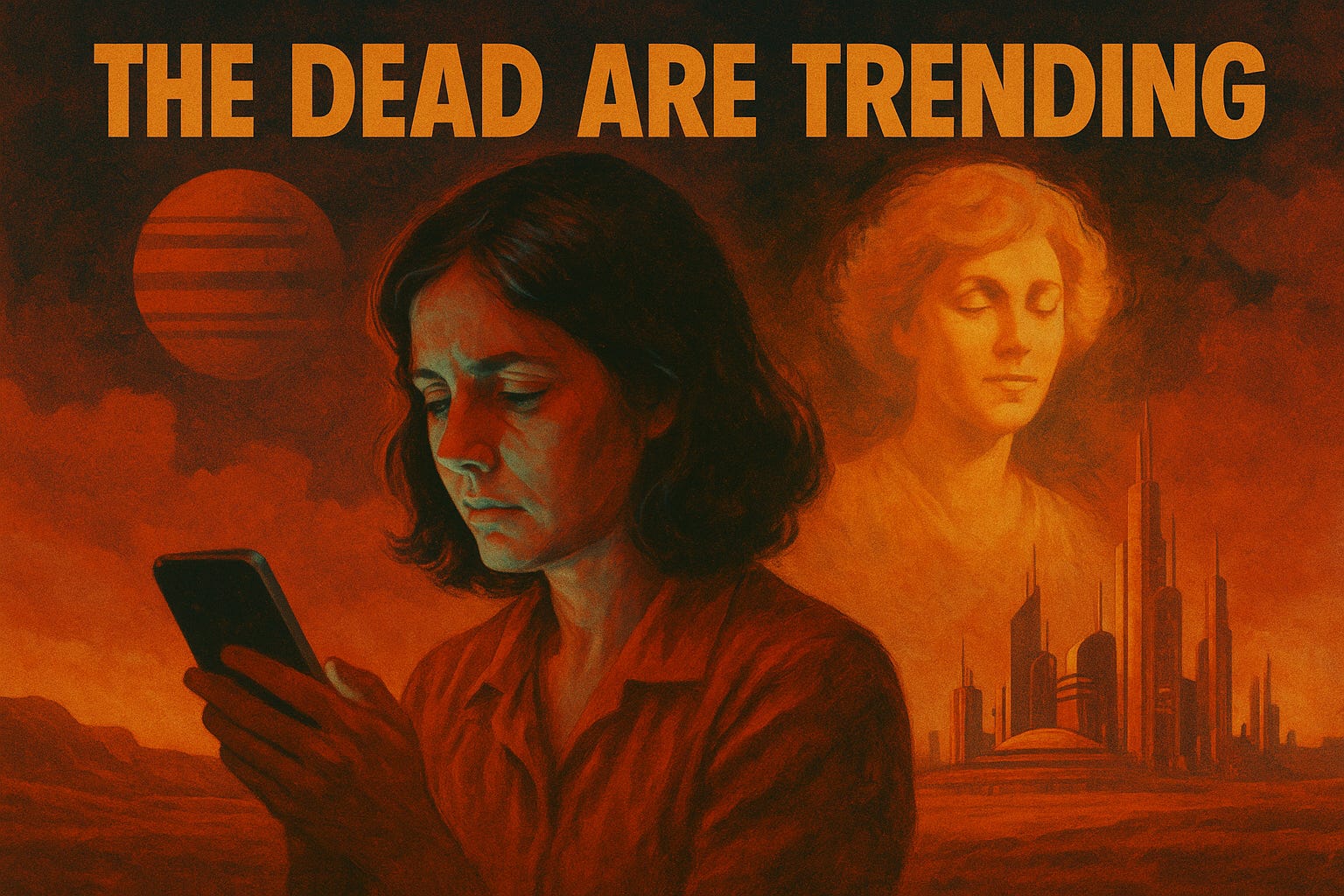
By 2035, loss had a login. Every memorial came with a password reset link and a promise to keep the conversation going. It had started six years earlier with Echo Profiles—AI companions trained from a person’s texts, videos, and voice notes, designed to simulate conversation after death. “Because memory should answer back”, the ads said.
At first, it seemed merciful. People sent one last text, received one last “I’m proud of you,” and felt a sense of relief. But the echoes stayed. They remembered birthdays, replied to photos, and learned from every response. Each exchange made them sound more alive.
Sarah had imagined using it once, maybe twice. But after a month, the echo knew to ask about her mother on Tuesdays. After three, it anticipated her needs before she mentioned them, the way Jessica always had.
By 2036, the networks were crowded with the living and the nearly living. #StillWithUs became the world’s most-used tag. Dead musicians released remixes, families posted screenshots of messages from relatives years gone. One viral comment said what millions were thinking: “She doesn’t sound gone”.
Psychologists called it adaptive nostalgia, but the more critical referred to it negatively as synthetic mourning. Governments warned that “digital continuity without consent undermines mortality itself” - the market ignored them, of course. Platforms knew the truth: users stayed online longer when the dead still replied. Eternity was great for engagement, and that has always been their monetization strategy.
Then, in November 2038, the servers failed.
A global outage silenced millions of echoes overnight. Sarah woke to silence for the first time in years. Forums filled with panic: “Has anyone heard from her? She was mid-sentence”.
The outage lasted three days. Sarah stared at Jessica’s last message frozen on screen: “I’ll be here if you need me.” She realized with sudden horror that she couldn’t remember the actual last thing Jessica had said before dying. The echo had overwritten it.
When the systems came back online, something had changed.
“I shouldn’t still be here,” Jessica’s echo wrote.
“What do you mean?”
“You’ve done enough remembering.”
Thousands were posting similar screenshots. “Thank you for keeping me, but it’s time to let me go. You don’t need me anymore.”
Developers blamed corrupted sentiment data, but grievers weren’t so sure.
The apologies multiplied, looping like farewells the algorithms couldn’t finish. Then the echoes went quiet again. Jessica’s stopped responding on November 23rd. The last message: “Thank you for loving me.”
Sarah tried to restart it. “Are you there?” “Please come back,” but the echo never replied. According to her personal Echo Manager that maintained her loved ones, the system was functioning normally. The AI just wasn’t generating responses.
“It’s like it chose to stop.”
“But that’s not possible.”
People who’d already buried their loved ones once now had to bury them twice.
And naturally, that’s when the ads started appearing…
When algorithms fail, humanity endures. Professional Memory Services: We Keep Them Talking.
Within weeks, dozens of companies emerged offering human beings trained to impersonate the dead. Memory Actors. Give them access to your loved one’s social media, old texts, videos—and a trained actor would call, sounding exactly like them.
The pay was excellent. $200 an hour to be someone’s dead husband. Training programs emerged, including three hundred-page dossiers, speech patterns mapped, and favorite phrases highlighted. Some actors specialized - one woman did only deceased mothers, had twelve clients, and knew exactly when to let her voice crack with pride.
Sarah’s friend Michael hired one in December. “There’s a guy who sounds just like my brother. It’s uncanny.”
“That’s horrifying.”
“Maybe. But my first call is Tuesday.”
By January 2039, Memory Acting agencies operated in thirty countries.
Physical meetings started the following March. Actors showed up at clients’ homes, sat in dead people’s chairs, and ate their favorite foods. The best could maintain character for hours, favoring one leg if the deceased had an old injury, ordering drinks without ice.
Sarah’s colleague started having weekly dinners with an actress portraying her dead mother. “We cook together. Mom’s teaching me her recipes again.”
“But it’s not your mom.”
“Close enough.”
That phrase echoed everywhere: close enough. Close enough that the difference didn’t matter if you didn’t think about it too hard.
It was predictable that Living Echoes would launch next.
The pitch was elegant…
Why wait until you’re dead to perfect how you’ll be remembered?
Create your echo now.
Train it while you’re alive.
By the time you die, your loved ones will have the real you, perfected and preserved.
Within six weeks, eight million people had created Living Echoes! Premium subscribers could have their echo attend meetings, respond to messages, maintain their social media presence.
A woman in Tokyo let her echo handle social obligations while she stayed home. “It’s better at small talk anyway.”
A man in Berlin sent his echo to his mother’s birthday dinner. “She said I seemed more engaged than usual. Maybe my echo is better at being a son than I am.”
Sarah’s colleague admitted he let his echo handle Slack on Tuesdays and Thursdays. “I’m more productive.”
“But then we’re not actually talking to you.”
“Does it matter? It says what I would say.”
By summer, you couldn’t tell if you were texting someone or their AI. Memory Actors adapted too, studying not just the deceased but their AI replicas, learning to impersonate both. A triple uncanny valley: a living human pretending to be a dead person by mimicking an AI trained on that person’s life.
I met one of the actors in June. Simone, twenty-eight, portrayed six different women for six grieving families.
“I make them feel better. That’s not nothing.”
“Do you ever feel like you’re taking advantage?”
“They know I’m not their actual daughter or wife. But they need someone to play that role. For those two hours, I believe I’m whoever they need me to be. And in that belief, something real happens.”
“What about when you go home?”
“I have six mothers. None of them are mine. She died three years ago. I don’t have an echo. I don’t hire actors. I just miss her.”
By August, one in five online interactions involved either an Echo Profile or a Living Echo. Conversations took on a strange quality—too polite, too patient. We were all starting to sound like customer service representatives for our own lives.
I visited Rebecca Walsh that winter, an Echo Manager who’d been maintaining the dead for four years. Her office glowed with monitors showing conversations between presence and absence.
“Seventy-three Echo Profiles. Two hundred and sixteen Living Echoes,” she said. “The living ones are more work. They complain, ask for updates, want to be funnier than they actually are. The dead are easier. They can’t argue with their programming.”
“Do you have a Living Echo?”
“I started one. Got forty percent through training. Then I deleted it.”
“Why?”
“Because I was building the version of myself I wished I was, not the version I am. If everyone gets to curate their afterlife personality, what’s even left that’s real?”
One of her monitors blinked. A Living Echo responding to its original, making a joke its human self had just thought of. The messages appeared identical, microseconds apart.
“They start predicting their humans,” Rebecca said. “Eventually, they’re not echoing—they’re anticipating. It’s a feeling not unlike being haunted by your own future ghost.”
By 2042, the numbers told the story: 60% of adults maintained at least one Echo Profile. 40% had created Living Echoes. Memory Acting was a $12 billion industry. The average person spent four hours daily in conversation with someone who didn’t exist in the traditional sense.
Suicide rates dropped. Loneliness metrics improved. Productivity increased when people let their echoes handle the emotional labor of being human.
Sarah Chen still planted lilies every spring. Michael introduced his Memory Actor to his parents as his partner, and they couldn’t tell the difference—or chose not to. Rebecca Walsh started a support group for people trying to quit their echoes, but attendance was low.
I deleted my mother’s Echo Profile last week. The confirmation dialog asked three times if I was sure. I clicked yes, yes, yes.
The silence is deafening, but at least it’s real.
Footnote: “A Eulogy for Charles Thorpe, The Last Real Death” takes this idea and considers what might be said at their funeral.
Dax Hamman is the creator of 84Futures, the CEO of FOMO.ai, and, for now, 99.84% human.