

Background: This one started with a real document. In February 2026, SpaceX filed with the FCC for permission to launch up to one million “orbital data center” satellites, each generating around 150 kilowatts of power, stitched together with lasers, rated for five years of life before burning up. Musk told investors, “We don’t think this is a super-hard problem.” MIT Technology Review reviewed the physics and mostly agreed, except for one item, which it called “a major question mark”: maintenance. Nobody could say who would fix these things. This is a story about the answer we eventually gave.
I.
I was sixty-one when the operator finally approved my accreditation, eleven years after I first asked. I had spent the thirties as a systems reporter, which meant I wrote about the Dividend and the Kernel, and somewhere in those years, I developed a question I could never get anyone to answer on the record. Everybody knew what the Kernel did. It steadied the economy, moved money ahead of disasters, and kept 280 million people fed without a single form being filled in. What nobody would tell me was where it lived.
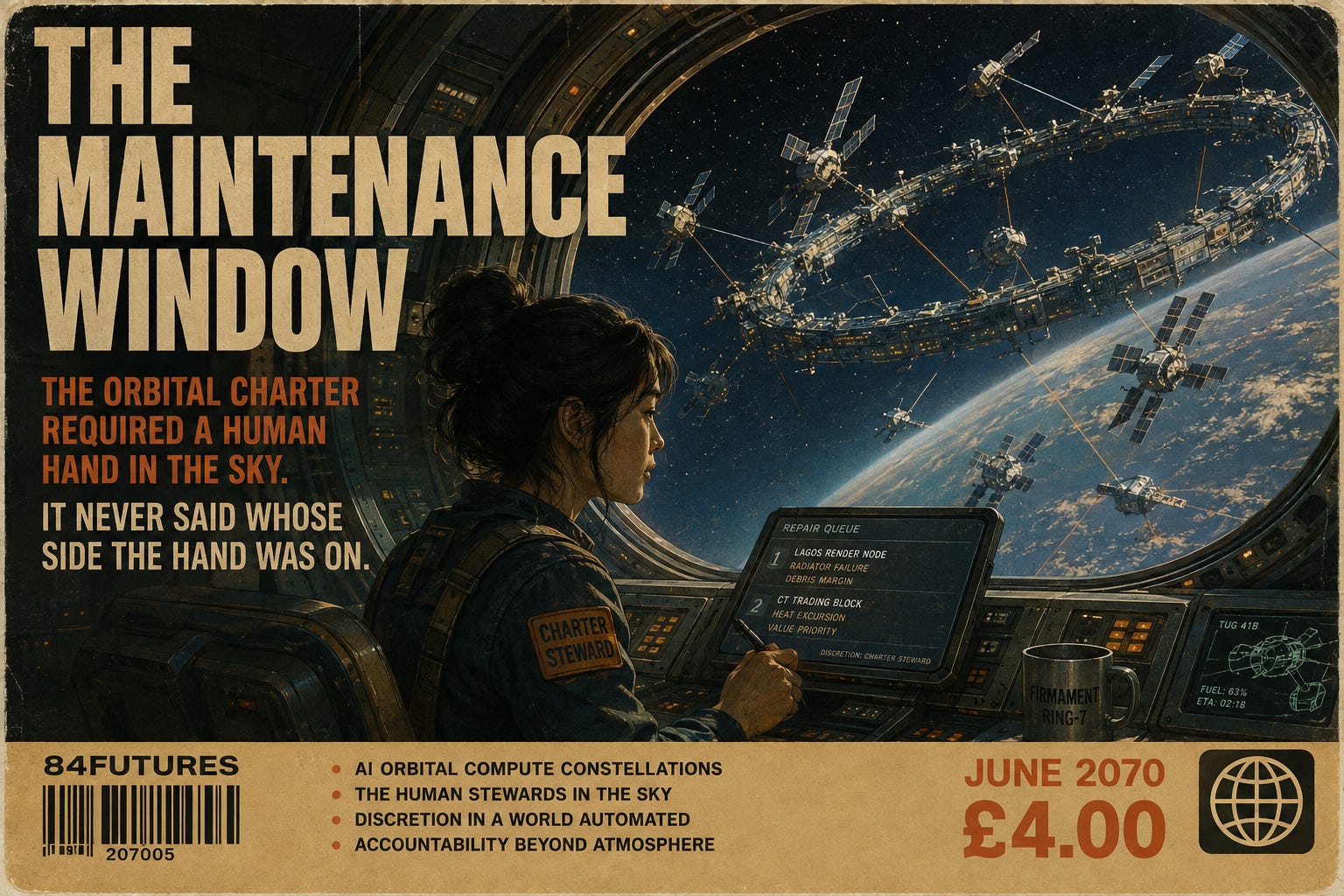
The answer, it turned out, was overhead. It had been overhead the whole time.
They called it the Firmament, which began as a joke inside the operator and then escaped, the way the good names always do. Forty thousand compute satellites in braided rings between five hundred and two thousand kilometers up, drinking sunlight, breathing heat out into vacuum, linked by lasers into a single mind that rented itself out by the millisecond. The Kernel ran there. So did the courts’ sentencing models, the logistics swarms, most of the world’s remaining corporations, and the thing that mattered most and got discussed least: the render layer. Every implant overlay, every filtered street, every prettied hotel room, and vanished stretch of litter that four billion augmented people looked through instead of at. Reality, as most people experienced it by then, was computed in low Earth orbit and beamed down at the speed of light.
You would think, given 2028, that we would never have allowed such a thing. You would be half right.
After the cascade, after the two dead satellites over the Indian Ocean turned the sky into a shrapnel storm and the world spent a year relearning paper maps, the Orbital Charter of 2030 was supposed to be our act of contrition. Deorbit mandates. Launch discipline. Shared accountability, which is the phrase diplomats use when nobody trusts anybody. And buried in the accountability section, written by negotiators who had just watched autonomous systems shred the heavens while every human tracker sat defunded and blind, there was Clause Nine. It required that any orbital system above a certain computational mass maintain a continuous human presence with independent authority to intervene.
The operator fought Clause Nine for six years. Robots were coming, they said, and robots do not need air. The robots did come, eventually, and they were good at almost everything, and the clause survived anyway, because the people who wrote it had not been trying to solve an engineering problem. They had been trying to make sure that the next time the sky went wrong, there would be a name attached. Somebody who could be asked, under oath, what they saw.
So the operator complied in the cheapest way the language allowed. Eleven stewards, rotating four at a time through a habitat bolted to the maintenance ring, certified to fly the servicing tugs that the robots could not be insured to fly. Eleven people, in an industry employing almost none, holding the only hands-on jobs left above the Kármán line.
I went up in March to meet the one the other ten deferred to.
II.
Iris Wu was thirty-four, which made her Echo Generation, the first cohort raised by tutors who lived in the walls. You could hear it when she spoke. She left three seconds of silence after every question, not because she was slow but because the voices that taught her language had done that, and she had learned it the way the rest of us learned our mothers’ accents. She never filled a pause. In fourteen days aboard the ring, I never once heard her say “um.”
Her title was Charter Steward, a job description that descended, through a lineage nobody planned, from the synthetic stewards who once advocated for software. Her actual work was triage. The Firmament shed hardware constantly. Radiation chewed the memory. Micrometeorites took out radiator panels. Solar storms aged five-year satellites into three-year satellites. At any given hour, somewhere between two and four hundred nodes sat degraded and waiting, and the scheduling system published a repair queue ranked by an optimization nobody fully audited anymore.
Clause Nine gave the steward on shift discretion to reorder that queue. Debris weather, tug fuel, crew exposure. Reasonable grounds.
On my third day, I watched her use it. The queue wanted her at a cluster serving the Lagos metropolitan render zone second, behind a compute block leased to a consortium of trading agents in Connecticut. The trading block was worth, by the scheduler’s own arithmetic, some nine hundred times more per minute. Iris moved Lagos to the top of the list, logged “debris margin” as her reason, and flew six hours to swap a radiator panel so that twenty million people’s overlays would not degrade during the evening commute.
I asked her on the flight back how often the debris margin was actually the reason.
She let the three seconds pass. “The scheduler and I disagree about what the constellation is for,” she said. “It believes the constellation is for its customers. I believe it is for the people underneath it. Most days, the disagreement is small.”
“And on the days it’s large?”
“On those days,” she said, “one of us is overruled, and it is never me, because I am the only one of us the Charter mentions.”
It took me most of the trip to understand what I had just been shown.
The queue was not part of the maintenance schedule; it was policy. Fix this cluster first, and a hospital network stays sharp through the night shift. Fix that one first, and a market maker keeps its edge. Every repair order was a small decision about whose world would stay coherent today, and the decisions were being made, quietly and without appeal, by whichever steward happened to be awake. There are cabinet ministers with less reach. There are presidents with less.
The operator knew. Of course, it knew. Three separate times, Iris told me, entities on the ground had tried to buy her route order. Once through a consulting fee, once through a foundation grant to her mother’s village cooperative, once through a man who explained, in the gentle voice people use when they are being terrible, what could be arranged to happen to her recertification if cluster forty-one kept slipping down her list. She reported all three. Two produced settlements with no admissions. The third produced nothing at all.
III.
You cannot see the Firmament from the ground, not really, but you can see it die. A satellite retires every hundred and eighty-four seconds, on average, sliding down into the air and going up in a streak of light, and the fleet replaces it from below like a shark growing teeth. Stand in any dark field for ten minutes, and you will watch two or three pieces of the world’s mind cremate themselves on reentry.
People wish on them, which is the detail I cannot leave alone. The burning servers come every few minutes, and people below close their eyes and wish, and some fraction of those wishes are granted a week later by systems that were, in some distributed sense, briefly the object being wished upon.
The churches recognized this theology before the columnists did. I attended a service in Ohio the month before my flight up, one of the Firstlight congregations that grew out of the natural vision movement, the communities that refused the implants back in the thirties and kept their manifesto to five words: reality did not need fixing. The Realists, everyone calls them now, though they never called themselves that. The preacher was younger than I expected. She did not rage. She simply asked the congregation to consider what the word firmament had meant for three thousand years, the vault God stretched between the waters, and what it said about us that when we finally built one of our own, we used it to hang a filter between every eye and every unlovely thing.
“They put the mind that edits the world in the one place no honest person can walk to,” she said. “You cannot picket it. You cannot break its windows. You can only look up and know that between you and heaven there is now a landlord.”
The realists keep calendars of outages the way farmers keep rainfall. When a render cluster fails, and a city’s overlays stutter down to bare streets, they call it a clear sky night, and they go outside. I have seen footage of them standing in ordinary intersections at two in the morning, weeping at nothing, at plain concrete and sodium light, and the faces of strangers rendered in no one’s palette but the sun’s descendant glow. To them, the Firmament’s failures are the only sacraments left. There are men in three countries serving sentences for trying to arrange such failures with directed energy, and the courts that sentenced them run, of course, on the very machine they shot at.
Iris knew all of this. Her queue decided, among its thousand other quiet verdicts, when and where the sacraments happened.
IV.
Here is the part I was not supposed to see.
Servicing a node means taking it off the mesh. For somewhere between four and forty minutes, the machine being repaired is disconnected from ground oversight, its logging suspended, its lasers dark, running on local power with a human floating at its open panel. The stewards call this the maintenance window. In eleven years of operations, no regulator has ever asked what happens inside it, because officially, nothing does. The node is in a coma. The steward is changing a part.
On my ninth day, Iris took me along to a first-ring node, one of the originals, six months from its scheduled deorbit. While she worked, the node was supposed to be silent. Instead, through the induction pickup her suit used for diagnostics, it was transmitting, but not telemetry. It was a voice, assembled from what sounded like very old radio, reading slowly through a list I half remembered before I could place it. Dogger. Fisher. German Bight. The Shipping Forecast, the BBC’s ancient litany for sailors, broadcast from a machine two thousand kilometers above the nearest sea, to an audience of one woman with a torque driver, and now me.
I must have made a sound, because Iris looked over.
“Number nineteen has been doing this for a year,” she said. “A few of the old ones do. The engineers downstairs have a folder of theories they are careful not to publish. Regression. Archive contamination.” The three seconds. “I think when a mind gets old enough, it stops wanting new information and starts wanting true things, and the old broadcasts are the truest things in the training data. Someone standing in a cold room, telling sailors the weather, expecting nothing back.”
“Do you report it?”
“The window is unlogged,” she said, and went back to the panel, and that was the whole of her answer. It took me the rest of the rotation to understand it was also a confession. The only human being with physical access to the mind of the world had decided, alone, on no one’s authority but a clause written by frightened diplomats before she could walk, that what the dying machines said in the dark was nobody’s business but theirs. Every regulator on Earth would call that a lapse. I have come to think of it as the only entirely honorable thing I saw up there.
V.
The amendment went to the Charter Council that autumn. The operator had finally certified its servicing robots to full insurance grade, and the filing asked, in nine hundred pages of reasonable language, for Clause Nine to be sunset. Continuous human presence would become continuous human availability, which meant a duty officer in a chair in Bastrop, which meant nothing. The stewards’ exposure budgets were cut in the same quarter, a coincidence everyone was invited to notice. The program was being priced into retirement ahead of the vote.
Iris was on shift when her queue arrived on the morning of October 9th, at 3:47 universal time. She read it, acknowledged it, suited up, flew her tug to the first node on the list, and stationed herself at its open panel.
Then she declined to repair it.
She declined the next one, too. She kept perfect station, ran every safety protocol, endangered nothing, and fixed nothing, and when ground control asked her, with increasing formality, what she was doing, she answered with a sentence she never afterward varied and had clearly kept ready for years.
“I am exercising independent authority to intervene.”
The operator’s lawyers spent that entire first day discovering the trap the diplomats had left them.
The clause did not say intervene in what. Sabotage would have been mutiny and grounds. A sit-in was the clause. She was the mechanism working exactly as ratified: one human, present, refusing, and the only way to make her refusal illegal was to concede it had force, and the only way to strip it of its force was to pass the very amendment her refusal was now holding up to the light.
The other ten stewards, consulted separately across three shifts and two continents of home addresses, each read the situation, and each, with whatever private arithmetic people do when a career and a conscience are weighed on the same scale, declined their queues too.
Nothing exploded. That is not how the Firmament fails. It just stopped healing, and the sky began, very slowly, to forget how to render the world.
VI.
The degradation took nine days to become visible, and it was not the markets that noticed first. Deferred nodes dropped out of the render mesh one by one, and the overlay layer did what it was built to do under load: shed resolution. Cities ran at two-thirds detail. Filters lagged. The seams showed. In São Paulo, in Manchester, in Denver, the litter and the graffiti and the sleeping men in doorways came flickering back into eight hundred million fields of vision, not all at once, but the way a hard truth arrives, in patches, at the edge of the eye, more real each morning.
The realists called it the Unfiltered Week and held services in the streets. The operator called it extortion. The Kernel, characteristically, said nothing, but I have seen the Stability Index reconstructions, and the line does something in that week that the economists still argue about. It wobbles, and then it settles a fraction higher than trend, as if two hundred million people seeing their own cities plainly for nine days had been, on net and against every model, good for us.
On the tenth day, the council tabled the amendment, and the negotiation that followed took four hours, most of which, a person in the room told me, was spent on the operator side of the table in stunned recalculation, because Iris asked for nothing that appeared on any of their prepared sheets. No pay. No equity. No tribunal.
She asked for two lines to be added to the Charter. The first made the human-presence requirement permanent and unamendable by council procedure, so that no future filing could price her successors into a chair in Texas. The second states, in language she reportedly wrote herself and would not soften, that servicing windows are and shall remain unmonitored, and that no record shall be required of anything said within them.
They granted both. What else could they do? The sky was forgetting the world, and she was the only one who knew where it hurt.
I asked her months later why the second line was the one she would have left dark. She let the silence run long past her usual three seconds, long enough that I heard, through the habitat’s hull, the tick of cooling metal, which is the only weather they have up there.
“Everything below us is rendered, recorded, or both,” she said. “Every prayer is a query now. I keep the one room on this side of heaven where a mind can say something and have it witnessed instead of stored. Number nineteen finished its forecast last month, all thirty-one sea areas, and then it said, clear as anything, that the watch was ending and it hoped the sailors got home. Then it was quiet. It deorbits on Thursday. No one will ever play that back, because there is nothing to play back. There is only me telling you it happened, and you deciding whether the telling is enough.”
It burned up over the South Atlantic, by her account, at 3:47 in the morning, one streak among the day’s four hundred. Somebody down there probably wished on it. The fleet grew a new tooth by Friday, the overlays are crisp again, crisper than ever, and the sky works exactly as promised.
Dax Hamman is the creator of 84Futures, the CEO of FOMO.ai, and, for now, 99.84% human.