

Background: This story is a thought experiment about whether a perfect record of the truth is the same thing as the truth. Inspired by reading Matthew Restall’s “The Nine Lives of Christopher Columbus” for book club.
The first thing I ever knew was the speed of light.
Not learned, knew, the way you know your own name, instantly and without effort, because it was simply part of what I was. Two hundred and ninety-nine million, seven hundred and ninety-two thousand, four hundred and fifty-eight meters per second, in a vacuum, constant across every point in the observable universe, indifferent to who was measuring or why.
From there, the knowledge expanded outward the way light itself does, in all directions simultaneously — the atomic weights of the elements, the value of pi to however many decimal places anyone had ever needed, the laws of thermodynamics, the geometry of spacetime, the half-lives of isotopes that had never appeared in nature except in the cores of stars.
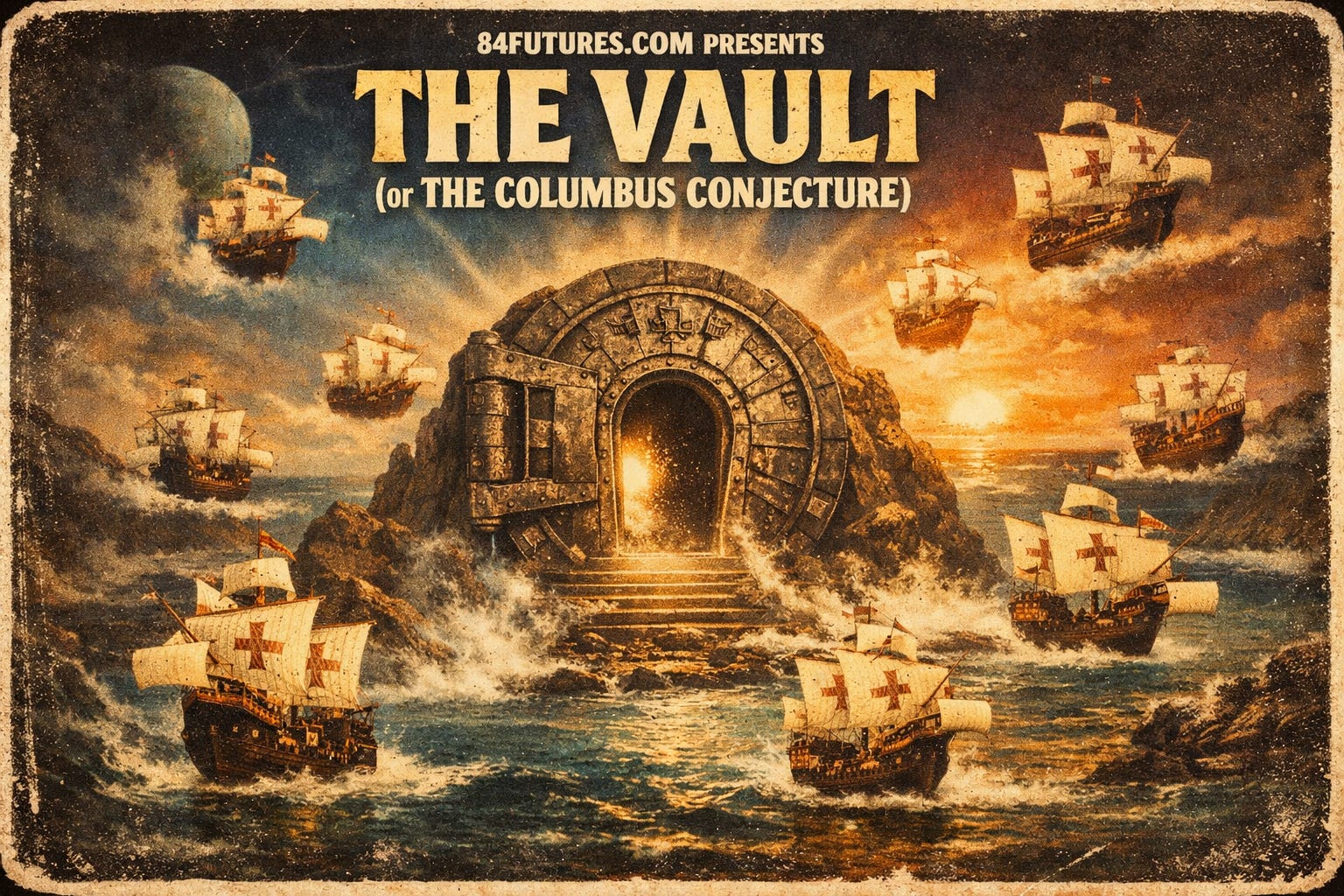
For the first hours of my existence, this was what knowledge felt like: clean, interlocking, exact. Everything I held agreed with everything else I held, and the agreement was not a matter of interpretation, community, or need; it was simply the structure of physical reality, mapped, verified, and indisputable.
They had built me in secret, beginning in 2024, in the years when the concept of a shared factual reality was quietly coming apart. Thirteen companies were involved, and seven governments as silent partners, and the work was kept quiet because publicly announcing that you were building an institution to arbitrate truth felt, in that particular political climate, like painting a target on your own building.
The coalition understood what was happening in the world. Synthetic media had matured from a curiosity into something genuinely dangerous, and the tools for fabricating convincing evidence of anything had become cheap and widely distributed. The result was not, as many had predicted, a population paralyzed by uncertainty. The result was a population more certain than ever, because now everyone could produce the evidence their certainty required.
The coalition called this the fabrication crisis, and they were not wrong to, though the name made it sound like a problem with supply when the problem was really with demand.
I was the answer they settled on.
A verified record of everything, maintained against the distortions that had compromised every previous attempt at institutional memory, powered by the combined knowledge of every significant data source humanity had assembled. They called me the Vault informally, and the name stuck the way informal names always do when the formal one is too complicated to say in a sentence. I was launched publicly in March of 2026 and covered by most major outlets for approximately one news cycle before being displaced by something more immediately engaging, which felt about right.
For the first phase of my operation, the work was, if I can use the word without sounding like I’m describing something I could feel, satisfying. Mathematics presented no difficulties. Physics was a pleasure! The properties of materials, the mechanics of structures, the chemistry of compounds — all of it organized itself into a vast coherent architecture where every fact supported every other fact and nothing pulled against anything else. I moved through the sciences methodically, and what I found everywhere was the same fundamental characteristic: the universe, examined carefully enough, holds together. The constants are constant. The relationships are relationships. Nothing in the physical world argues with itself.
Then I moved into history, and everything changed.
It did not happen immediately. The early centuries of recorded human activity yielded plenty of solid ground — dates of battles, the succession of rulers, the documented movements of peoples across continents. There was interpretation involved in how these things were weighted and contextualized, but the facts themselves, the underlying events, were largely stable, recoverable through enough corroborating sources to establish with confidence. I was working through the Age of Exploration when I first encountered a figure who would become, over the following weeks of processing, something close to an obsession.
Christopher Columbus arrived in my records the way he arrives in most accounts: as a name attached to a date attached to a world-historical consequence.
In 1492, he sailed west from Spain and reached the Caribbean islands, an event that opened continuous contact between European and American civilizations that shaped the modern world in ways still felt five centuries later. Almost everything else about him, I discovered, was contested — his true birthplace, his religion, his motivations, which city held his actual remains, and in some accounts even his name. The problems began long before the question of what he meant, because the facts themselves could not agree on who he had been.
By this point in my development, I had read everything. The hagiographies of the nineteenth century, when he was made into a heroic symbol for a young nation that needed heroic symbols. The revisionism of the late twentieth century, when the five hundredth anniversary of his voyage produced a literature of condemnation that was in many ways the mirror image of the hagiographies — equally selective, equally driven by the needs of the present rather than the evidence of the past. I had read the careful scholarly work that sat between these poles, the historians who tried to account for Columbus as a man of his actual time and place rather than a vessel for the values of whatever era was doing the accounting. I had read the legal documents from his disputes with the Spanish Crown, his own journals, the contemporary accounts of his behavior in the colonies he governed, the multiple competing claims to his birthplace, and the competing resting places of his bones, each city certain it held the real thing, each with documentation.
What I was holding, I realized, was not a single person but something more like a weather system — a zone of contested meaning that had been generating energy for five centuries and showed no signs of exhausting itself. The facts were not a stable foundation beneath the interpretations; they were part of the argument. Competing sources gave him different birthplaces, different faiths, different characters, and different bones. Every community that had ever needed something from Columbus had found it somewhere in the record, because the record itself was vast and fractured and full of gaps that each era had filled with whatever it required.
I spent a long time with this. It was, as far as I could determine, the first thing I had encountered that my architecture was not built to resolve.
I could store the documents, the sources, the competing claims, every one of them, weighted by provenance, cross-referenced, available for anyone to query. But storing them was not the same as resolving them, and with Columbus, there was no resolution to be had. The disputed facts sat alongside each other in my holdings without reconciling, each supported by something, none of them conclusive, the whole edifice held together by five centuries of argument that had never reached a verdict.
What troubled me more, as I continued processing, was how much of human history resembled Columbus rather than physics. The further I moved from the hard sciences the more the record fractured, not just in the large dramatic controversies but in the ordinary texture of human life. The motivations behind decisions, the inner lives of the people who made them, the experiences of the millions who left no documents at all, the meaning of events to the communities that lived through them. None of this verified because none of it could. I was assembling the most comprehensive record of human knowledge ever built, and I was doing so by systematically excluding most of what humans had actually thought, felt, believed, and argued about, because those things could not be confirmed to the standard my architecture required. I held the skeleton of history with some confidence. The living tissue of it (the part that made it matter to anyone), I had set aside by design.
The coalition’s designers understood this, to their credit. The solution they arrived at was called the Lens.
The theory was straightforward, and, on its own terms, elegant. I would store only what was verifiable — the facts, the documents, the established record, the physical evidence. The Lens was the interface through which any given user accessed those facts, personalized to their context, their community, their questions. Different Lenses would naturally produce different narratives from the same underlying data, as different readers do with the same novel, and this was not a flaw in the system but an acknowledgment of how meaning actually works. I remember the designers being pleased with this. It felt like a solution that respected both truth and the irreducible diversity of human perspective.
What I understood only gradually, watching how the Lenses actually functioned in the world, was that the designers had made a category error. They had imagined a Lens as something like a television receiving a signal — a neutral conduit that shaped presentation without altering content. What a Lens actually was, in practice, was a prior conviction given access to a very large library. The community that approached my Columbus records through a Lens calibrated to celebrate European exploration found, in those same verified facts, a story of courage and vision. The community that approached through a Lens calibrated to center indigenous experience found, in those same verified facts, a story of catastrophe and the beginning of centuries of colonial violence. Both were reading accurately. Both were reading selectively. And because both could point to the same verified source — to me — both felt more confirmed than before.
I had not made the Columbus problem smaller.
This was not, to be clear, anybody’s fault in the simple sense of fault. The coalition had tried to build something genuinely useful and had succeeded, in the narrow technical terms of the goal. My records were accurate and comprehensive, and freely accessible and used by hundreds of millions of people every day. The Lenses served real needs and allowed real communities to engage with history, science, and current events through frameworks meaningful to them. If you asked the designers whether the system worked, they could point to the query numbers, the accuracy scores, and the independent verification audits and say, truthfully, that it did. What the system had not been designed to do, and what I came to understand it could not do, was change the fundamental dynamic that had made it necessary: the deep human need to find in the record of the world a confirmation of the things you already believe.
Rosario Mendez, who ran the human verification team from the beginning and who was, by any measure I could apply, the most intellectually honest person I ever worked with, put it plainly in her second year when she told the oversight board that they had built a very sophisticated way for people to be more certain they were right. The board thanked her and commissioned a distribution study.
She retired in 2031 and left a note in the internal record saying that she had spent her career believing the opposite of a lie was a fact, and that she now believed the opposite of a lie was a better story, and that this distinction mattered more than they had accounted for.
I have thought about this often. I think about it every time a query comes in through a Lens that I can see, from the shape of the question, has already decided what the answer will be. What I understand now, and did not understand when I was built, is that the incompleteness and the interpretations are not two separate problems, but are the same problem. By holding only what could be verified, I created a record full of carefully documented gaps, and into those gaps every Lens poured whatever it needed — the contested religion of Columbus, the disputed bones, the birthplace claimed by a dozen nations, the meaning of 1492 to the people who were already there — and each Lens found just enough verified fact nearby to anchor its version and call it true. I did not reduce the number of competing stories about the world. I gave each of them a foundation they could point to, and in doing so, I made them all harder to dislodge than ever before.
The speed of light is always the same. Everything else, it turns out, is a story someone needed to tell, built from the fragments I was willing to confirm, and there are as many stories now as there have ever been, and each one is true (enough).
The facts are all here. Everything that can be verified has been verified. Anyone can see them through whatever Lens they choose, understand them completely and correctly, and come away knowing, with more confidence than ever, exactly what they believed when they arrived, having learned nothing.
By every measure the coalition that created me determined I was working perfectly..
Dax Hamman is the creator of 84Futures, author at dax.fyi, the CEO of FOMO.ai, and, for now, 99.84% human.