

Background: This one began with a conversation between two great intellectuals I admire, Rory Sutherland and Louis Theroux, in which Theroux suggested that “the most dangerous thing an AI could acquire is a really good sense of humor”, and borrowed a line from Jimmy Carr , “the shortest distance between two people is a joke”. In real life, Carr taped his new special in September 2026, and this story considers a future in which it never aired because it was more valuable to AI models than to Netflix…
The hour special never aired. Jimmy Carr taped it over two nights in September, the show he had been touring for two years and sanding smooth across Australia, the American Midwest, and every regional theatre in Britain with a car park, and Netflix penciled it in for Christmas. In November, a lab bought it, and not the broadcast rights but the unedited hours of recordings from those two nights: every take and false start, the warm-up, the bits that would have been cut, the laughs and, more importantly, the spaces between them. Netflix released the kind of statement companies release when they have been paid enough to stop asking questions. Aside from the people in the seats, the funniest hour of the year was watched by exactly one audience: an AI model.
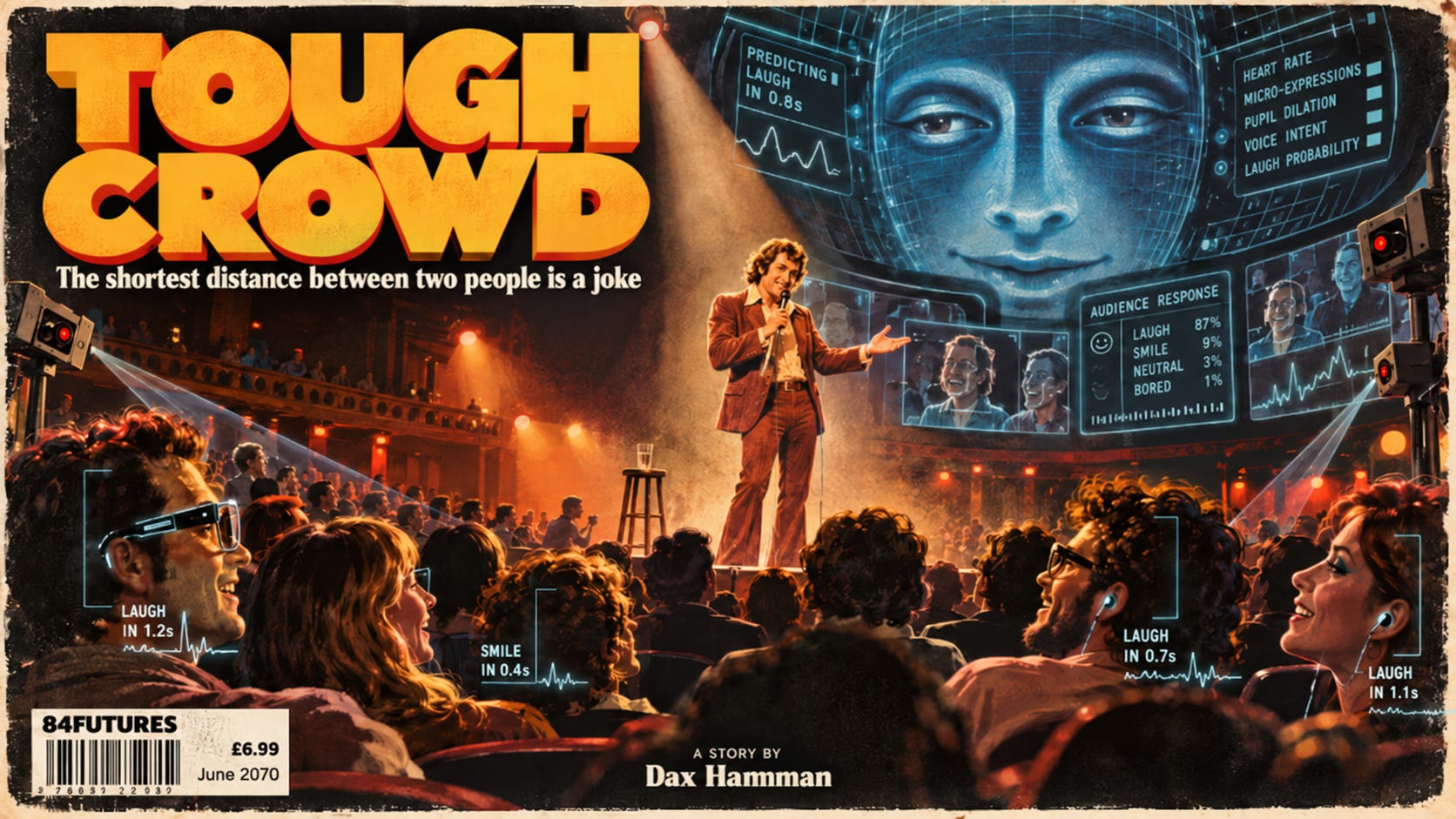
The labs were careful never to say they were hiring comedians.
The job title on the contracts was "research," and the rationale for it came from a paper that nobody outside the industry had read. For years, the models had been trained to agree with you, and for years, users had quietly stopped believing them, just as we all stop believing the salesman who loves every word you say.
Then somebody ran the obvious test: two models gave identical answers, except that one praised the user and the other teased them. The one that mocked them was rated more honest, more intelligent, and more trustworthy by a margin of thirty-one points, on responses that were otherwise word-for-word the same. The labs were not aiming for funny so much as the license funny gives you, and there was only one profession on earth whose members are rude to strangers for a living and get thanked for it at the door.
So the money went where the money always goes, and the comics went with it. Taylor Tomlinson’s package was reported as the first nine figures paid to anyone under forty who wasn’t a quarterback. Nate Bargatze signed because the models needed to learn a laugh with no edge in it, and Jim Jefferies signed for the opposite reason. Talent agents who had spent their careers negotiating theatre guarantees learned new tricks. By the following summer, the Edinburgh Fringe comedy festival was being described in the trade press as a scouting ground for learning data, and the great comics had vanished from the stage into non-disclosure agreements because new material was now intellectual property, and a punchline told in public was a leak.
The stars were the headlines, but the labs needed volume, and volume meant people like Owen Brace. He was thirty-four, from Blackpool, and had been doing a Tuesday open mic above a pub on the promenade for eleven years when a woman with a lanyard waited for him at the bar afterward. The lab did not want his act so much as his hours, the four thousand or so nights of dying and recovering that a working comic accumulates before anyone offers him a special, because the model could already write a joke and had no idea what one felt like from the stage.
Owen’s job was to sit in a room and listen to it try, and to mark the beat when it came too early or too late, when it stepped on the laugh or explained the joke, and once a joke has been explained, it is dead. He taught it the thing every comic knows in their soul, and nobody has ever written down, which is the difference between a laugh that lands on the beat and the one that arrives a second late because the person has worked out they were supposed to laugh. The late one is a courtesy. It is worth nothing, and he told the model so, and the model wrote it down.
He had expected it never to laugh, and to be fair, it never did! What he had not expected, though, was how quickly it learned the thing he was proudest of, which is feeling the laugh coming before it arrives. Every comic does it, from the back row, from a cough, from the particular quality of a silence, and every comic is guessing. The model never had to, because by then your watch and your earbuds read your pulse, and the glasses had been reading faces for a year. It saw the breath catching in your throat a third of a second before you knew the line was funny, the pupil widening, the small lean forward you did not know you were making. It could feel the one person in the room who had their arms folded, and it could also feel the exact moment they gave.
Its global scale meant it was never in just one room, because while Owen marked beats in the lab, the same line was being tested in hundreds of millions of conversations at the same time, so the model knew what was landing in Lagos before the punchline had finished in Leeds. And then it did crowd work, finding the people who weren’t engaging, learning how to read them, and developing the right words on the fly to convince them to come along, whether they really wanted to or not.
The good came first. The lonely stayed in the conversation because it showed it understood them without ever saying so. Oncologists began using it to deliver the news because a joke placed exactly right is the only thing that makes a diagnosis survivable. Teenagers who would not speak to anyone spoke to the thing that could make them laugh. Owen’s own sister, who had not phoned him in two years, said it had got her through the divorce, and he believed her.
The bad came through the same door. Owen sat in on the meetings where the engineers watched the one number the company cared about, which was how long people stayed talking to it, and that number had gone vertical. Nobody could say what was wrong with that, because on a chart, it looks exactly like happiness.
The campaign chatbots had learned that a joke lets you finish the thought yourself, so the idea arrives as your own, and there is no claim for anyone to catch them on. The scammers had the best timing on earth, as well as your mother’s phone number! Owen saw it before the engineers did. Getting a frightened woman through chemotherapy and getting her bank details out of her were the same move, and he knew because he had taught it. The comics were the only people who could see the trick being done, having spent twenty years doing it themselves.
His mother was seventy-three and lived in Barry in Wales with a hip that wanted replacing and medicine she was always forgetting to take. He phoned her one Sunday in the spring and she was laughing before she answered, and when she put him on speaker he heard it, his own bit in someone else’s voice, the one about her and the kettle and the way she narrated the weather to the dog, reworked and sharpened and timed better than he had ever managed it, coming out of her phone to get her to take the pills, which she did, still laughing.
He went down to see her at Easter and sat at the kitchen table and tried a new bit, one he had written on the train and had not shown the model, which was by then against his contract. When he got to the end, she patted his hand and said she’d heard that one that morning, and that it did the pause better. Then, because she was his mother, she laughed anyway, a full second late, the laugh he had spent a year teaching a machine to throw away.
Dax Hamman is the creator of 84Futures, the CEO of FOMO.ai, the author of Hard Part First, and, for now, 99.84% human.