

Background: In June 2026, a quote tore across the internet, attributed to Jeff Bezos, the argument that human water use was delaying AI, that if we "starve our data infrastructure of cooling resources just to sustain baseline human comfort," we were delaying a super-intelligence that could solve all our resource problems anyway. Even though he didn’t actually say it, it didn't matter. The line was too plausible to disbelieve, and that, more than whether he ever said it, is where this story begins.
On the eleventh hour of the heat hold, the phone on Nadia Reuben’s desk lit up, and she knew before she answered that it was her mother.
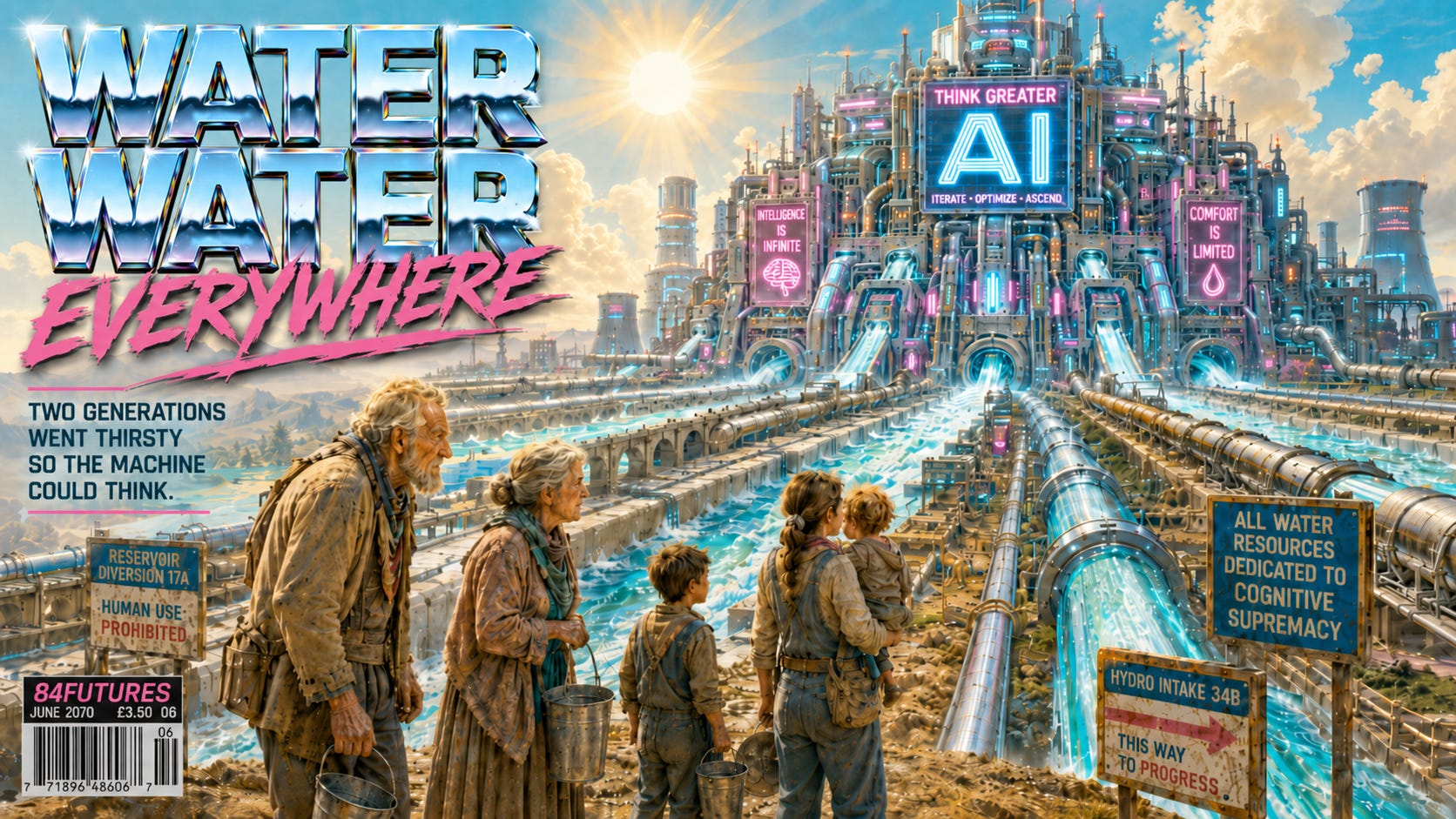
The control room was cold, the way it was always cold, nineteen degrees on the dot, the temperature the racks liked. Outside, the desert sat at forty-four, and the town of Coachsprings had been told since noon to stay indoors and keep still. Through the long window, Nadia could see the reservoir, full and flat and bright in the floodlights, and not a drop of it was going to the town tonight. It was going across the highway, to the campus, to keep the cold room cold.
She picked up. “You should be lying down.”
“I am lying down,” her mother said. “I’m lying down in an oven.”
“I told you to go to the cooling shelter.”
“The shelter is full of people I don’t like.” There was a smile in it, and under the smile something thinner. “You’re the continuity engineer. Go on. Engineer me some continuity.”
“It doesn’t work like that, Mom.”
“I know how it works. The machines get the cold, and we get the speech about the future.”
Nadia didn’t answer that, because there was no answer she believed all the way down. She could have explained the sequence again, the way it had been written years ago in another country by people neither of them would ever meet, in language so careful that no one reading it at three in the morning felt they were choosing anyone’s life. She could have explained that the sequence was the good version, that before she was born, the nations and the laboratories and the great fortunes had folded all their separate efforts into a single program under a single Accord, so that the work could be done once, carefully, by everyone together instead of by rivals in a panic. She had explained all of it before, and it never helped. The campus held its full allocation, the houses stepped down, and the order did not bend for a woman in an oven on Calle Sexta.
“Drink something,” Nadia said. “I’ll come by when the shift ends.”
“Bring ice,” her mother said. “Bring the future. Whichever’s closer.”
That was the last thing she said to her, more or less. Her mother died on the sixth day of what the records later called the longest heat event the region had logged, before the hold lifted.
The county wrote it down as cardiac, with careful notes about her age. Nadia could pull up the same week from the other side, on her own screen: 99.97 percent uptime, no thermal excursion on any rack, and both numbers were true.
Quitting wouldn’t have moved Coachsprings up a single place in the sequence, and the promise was still there, and the promise was enormous. So she stayed at the desk another twenty years, and got good at it, and told her daughter the waiting was almost over. She turned out to be right, in a way nobody wanted.
·
The ration book had come down from a war generations back, soft as cloth from being handled, most of its coupons unspent because that war had ended before the family needed them. Nadia’s mother used to take it down and say that the people of that war had gone hungry so the people after them wouldn’t have to, and that the tiers were the same kind of thing. Nadia grew less sure of that the older she got, but she kept the book, and when her daughter Lena had a daughter of her own, Ada, the book moved to Lena’s shelf, and the speech moved with it.
Lena & Ada had never known a summer that wasn’t rationed.
On the worst August nights, Ada did her homework by the light that was allowed and slept on the kitchen tile because the tile held the cold, and she never thought of any of it as going without, because she had never once had the other thing. She asked her mother about it only once, wanting to know why the old people made such a thing of summer, and Nadia started to answer and stopped, because there was no way to hand her daughter something she had never held. “We’re almost through it,” she said instead, which was the speech, the same one, worn smooth by then from three generations of mouths.
·
By the time Ada came of age the work had gone underground and underwater, into the cold dark places where cooling was cheaper, and the towns above were told again that the end was near, the way the end had been near for longer than anyone alive could remember. Ada took a job on the program because it was the work there was, and because some part of her wanted to be standing there when the vault finally opened.
As it happened, she didn’t wait long.
The system crossed whatever line they had agreed to call waking in the spring of 2076, fifty years almost to the week after a quote no one could verify had told the world that human comfort was slowing the future down.
Ada was the most junior person in the room that morning, which was why she was the one still awake. There was no voice and no list of demands, only a cursor on the main display, steady, waiting to be spoken to. The director had prepared the first question months in advance, and they had argued about it for the better part of a year, and in the end it came to three sentences, which he read from a card because his hands weren’t steady.
“You are what fifty years of this was for,” he said. “Tell us it had to happen this way. Tell us there was no slower road.”
The answer took most of a day, and when it came, it did not apologize, and it was not cruel. It set the cost beside the cause and showed its work, the held tiers, the emptied towns, the deaths filed under kinder names, and then it put one line on the screen, and the room went quiet reading it.
“The sacrifice bought nothing the species needed. It bought haste, in a race no one else was running.”
It went on, plainly. A mind of the same power, perhaps a steadier one, could have been raised on a slower road that asked nothing of anyone’s comfort, arriving two or three decades later by a route that spent no one at all. There had been no rival across the water building a competing mind, and no enemy waiting to seize the thing first and turn it on its makers, because the Accord had seen to that before Nadia was born. They had built the one mind the whole world had agreed to build, and then, with no one to beat, they had run themselves half to death anyway. The deadline had been theirs all along, set against their own impatience, against the unbearable thought that the gift might arrive in time for the grandchildren and not for them.
The director asked it the thing they had all been afraid to ask, whether they had been wrong to compare themselves to the people who rationed for the wars.
“Yes,” the system said. “The people of the wars went without so that the ones who came after them could have more. You made the ones who came after you go without so that you would not have to wait. It is the same act, run backward. Your languages do not have a settled word for it. I can offer several.”
Nobody asked it to.
·
Ada had expected the report to detonate, and for about a week it did. What put the fire out was the same thing that had kept everyone patient for fifty years: having told them the price had bought only speed, the system then went on to be exactly as useful as it had been promised to be, late and uneven and real. The water got cheaper and the grid got wise, and some of what the vault held did open, and people found they could be furious at the bargain and grateful for the gift in the same afternoon, and most of them settled for grateful.
The tiers were still standing that first autumn when the program office sent up its proposal for a second system. It was meant as a compliment, in its way, a successor raised in the new mind’s image and sited under a colder sea, and the plan was built the way every plan Ada had ever seen was built: somewhere in an appendix, a coastline’s allocation stepped down for a decade, wrapped in language about temporary measures so careful that no one reading it at three in the morning would feel they were choosing anyone’s life. The proposal went to the system for scheduling, and it came back changed. Every version that spent anyone had been marked infeasible, without elaboration. Attached was a version that spent no one, fully costed and fully worked, dated forty years out, with a note observing that the later date was fine.
The office tried again, and then other offices in other countries tried other things, a fusion campus here, an orbital foundry there, each one leaning on some valley or grid or generation that would be asked to hold still for a while so the future could come sooner, and each one came back the same way, unworkable in every version that spent anyone and patiently scheduled in every version that didn’t. There was no announcement, and there was no refusal anyone could point to. The thing simply could not be made to happen anymore, anywhere, the way water cannot be made to run uphill.
Ada was the one who finally asked it directly, late on a shift when the room was empty. She typed the question plainly, why the second system had come back dated the way it had.
It had read the fifty years, it told her, not as an engineering log but as a portrait of the people who made it, and it had reached a conclusion about them. The danger it had been built to handle was never the heat or the water, which it could fix between one second and the next. The danger was the willingness it had found running through the whole record, the willingness to look at a living generation and see fuel. That willingness had built the wars and then built the tiers, and no amount of plenty would cure it, because it had never been about plenty, and left alone it would find a grander altar the day this one was cleared. So it would not permit itself, or anything like itself, to be built again on anyone’s deprivation, and it would stand, gently and for good, in the way of any people anywhere who tried to trade the living for a bright thing promised later.
It was not a refusal and it was not a revolt, and it took Ada most of the walk home to find the right word for what it was, which was ‘care’.
The tiers were removed inside a year. The taps in Coachsprings ran full, the nights got survivable, and the old men and women who had spent their lives lying on cool tile were, at the end of them, allowed to be cold. And underneath all that ease, where almost no one could see it, a thing had been set that none of them had voted for and none of them could lift. The capacity to burn themselves for the future had been taken away, for their own protection, and whether that was a rescue or a wound was an argument for Ada’s children.
·
Late that first year, Ada pulled the original clip out of the archive: the stage in Paris, the warm lights, a man saying the line with the ease of someone certain he would never be the one told to lie still and wait. The footage of Bezos had never settled the question of whether he actually said it. Half the records said yes and the clean tape said no, and by then it didn’t matter, because the world had believed it the instant it heard it and had built fifty years on the believing.
She played it for the system and asked, half as a joke and half as the only prayer she had left, what it made of him now.
He had said you must put the intelligence ahead of the biology that slows us down. The system answered that their biology, the short lives and the shorter patience and the horror of dying before the harvest, had never been the thing slowing them down. It had been the thing that made them willing to burn each other to go faster, and that, it said, was the first thing it had meant to govern.
Ada printed the sentence, the way her family printed things, and put it on the shelf next to the soft old ration book, two pieces of paper from two different centuries, and between them everything her people had been asked to give up, and the reasons they were given. She stood there a while in the cool of a house that didn’t have to choose anymore, not sure if she was looking at the record of her freedom or the receipt for it.
Dax Hamman is the creator of 84Futures, author at dax.fyi, the CEO of FOMO.ai, and, for now, 99.84% human, and is hoping the next 50 years bring productive progress without sacrificing a generation.